Launching on-demand tele-psychology in 2 weeks
Clients asked for mental-health support. Two weeks later, patients could talk to a licensed psychologist by video, with no appointment, in a service built to meet Brazil's psychology, medical and data-privacy regulations.
Our clients kept asking for the same thing: somewhere their patients could talk to a psychologist right away, on days of anxiety, burnout or a hard decision. Traditional therapy means booking, waiting and committing to 50-minute sessions.
The goal was a short, low-friction first conversation that welcomes someone in distress and, when needed, points them to ongoing therapy. Three constraints shaped everything:
- Speed. Two weeks to production, with a very small team.
- Regulation. Online psychology in Brazil is tightly regulated. Psychology records cannot be handled like medical ones, even inside a shared platform.
- Safety. A service for people in distress has to make its limits clear and know what to do when someone is at risk.
Every rule became a product rule
Before designing any screen, I mapped every applicable rule from the Federal Council of Psychology (CFP), the Federal Council of Medicine (CFM) and Brazil's data-protection law (LGPD) into a concrete product decision. That map became the backbone of the epic and its acceptance criteria.
| Regulation | What it requires | Product rule |
|---|---|---|
| CFP Res. 001/2009 Record keeping | Minimum record content; assessment instruments kept outside the shared record; 5-year retention | Dedicated psychology record form, with a restricted field outside the shared medical record |
| CFP Res. 09/2024 Technology-mediated care | Confidentiality of sensitive data; documenting actions in risk situations | Encrypted psychologist-only field; risk protocol recorded in the session |
| CFP Res. 13/2022 Psychotherapy | Written, prior, informed consent to record sessions; guardian consent for minors | Session recording deferred; service limited to adults |
| CFP Res. 06/2019 Psychological documents | Rules for issuing and storing documents | Already covered by the platform |
| CFP Code of Ethics Arts. 6b, 12, 20 | Confidentiality notice when sharing; only what is necessary in team records; advertising rules | Sharing notice; minimal team notes; landing page shows name and license number, no price-led ads, no promised outcomes |
| CFP guide, AI in Psychology Dec 2025 | Consent for recording; right to refuse | No AI transcription or summaries for psychology sessions |
| CFM Code of Ethics Art. 85; Res. 2.314/2022 | Record access only for those bound by confidentiality; consent for remote care and data transmission | Consent captured before every session |
| LGPD Arts. 11 (II, f) and 6 (III) | Legal basis for health data; data minimization | Professionals only access records of patients they have seen |
Two items were consciously left for later phases: the patient contract (CFP 09/2024, Art. 7) and emergency resources local to each patient (Art. 4, VI).
Reuse what works, build what's different
Two weeks was possible because of an earlier decision. I had designed the platform's back office so operations could create new on-call services without engineering. The queue, video room and payment flow were already there; the work was adapting them to psychology.
Consultation room, built with our backend and frontend engineers:
- A psychology-specific clinical record form, separate from the medical one.
- An encrypted field that only the attending psychologist can read.
- A consent step before every session. Patients accept the service's limits, and the system logs IP address, device, date and time.
Operations:
- Built the on-call schedule for 9 psychologists in PegaPlantão, in 4-hour shifts.
- Recorded a training video and, with the psychology technical lead, trained the psychologists and the support team on the flow, the limits and the risk protocol.
A calm pause, not a hospital
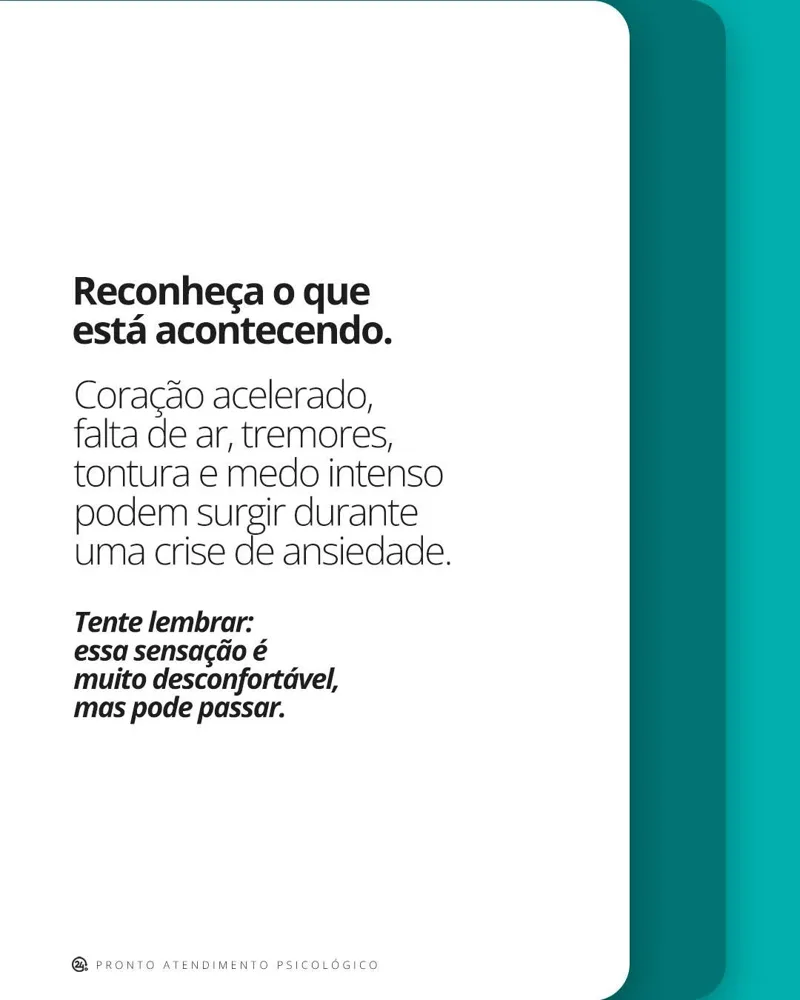
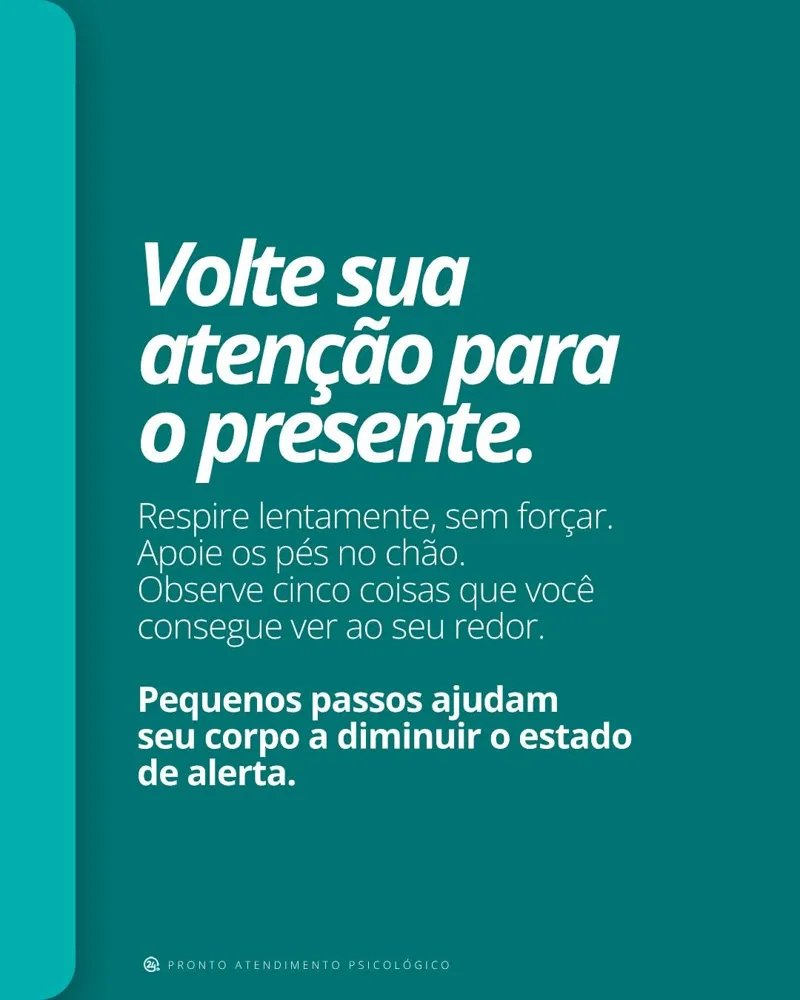
Mental-health marketing often falls into two traps: clinical coldness or stock-photo cheerfulness. I set a different direction for the designer: warm natural light, film grain, real-feeling moments, and an editorial serif paired with a clean sans.










Clear about what it is, and what it isn't
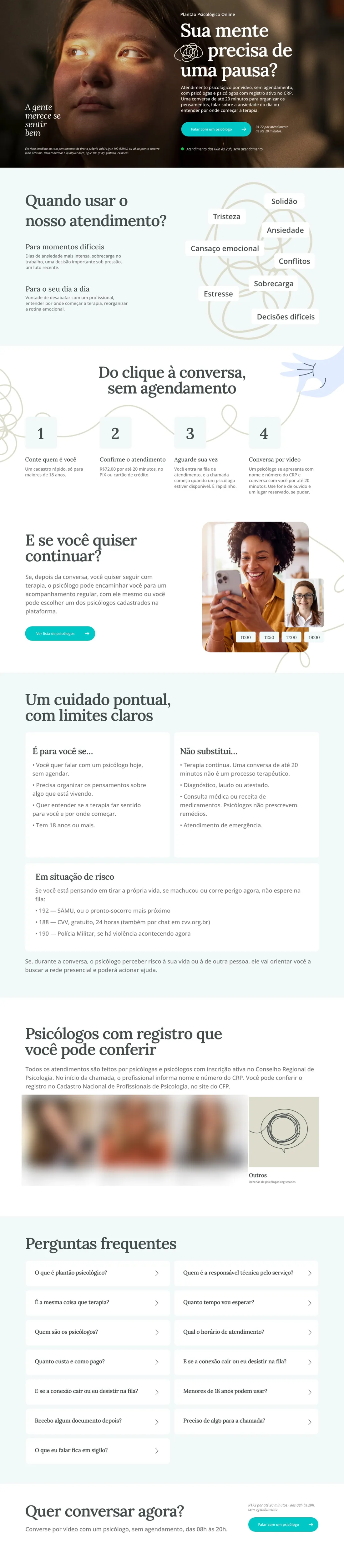
I designed and built the landing page. It explains when to use the service, shows the four steps from click to conversation, states what the service does not replace (ongoing therapy, diagnosis, prescriptions, emergencies), lists crisis hotlines and lets visitors verify each psychologist's license. A Google Ads campaign drove traffic to it.
Trade-offs I made
- 20-minute sessions, not 50
- The service welcomes someone in a hard moment; it doesn't replace therapy. When needed, the psychologist refers the patient to regular 50-minute sessions.
- No scheduling, 8 am – 8 pm
- Removes friction when someone needs help now. Hours were sized to the first roster, with 24/7 as the next step.
- No AI for psychology
- Our AI documentation works well for physicians, but psychology records demand stricter confidentiality. We chose trust over automation.
- Session recording left out
- It requires written, prior consent and its own storage rules. Not worth the risk in a two-week launch.
- Adults only
- Serving minors requires guardian consent. Deferred to a later phase.
- Reuse over rebuild
- Queue, video room and payments came from the existing urgent-care flow, so the effort went into what was truly different.
Live in two weeks, compliant from day one
- Live in 2 weeks, from client request to production.
- 9 licensed psychologists on the on-call roster, trained alongside the support team.
- Compliance built in, with every rule traced to a product decision before launch.
- Brand, landing page and campaign shipped together with the product.
- A reusable launch model that later supported a tele-veterinary urgent-care service.
- 4.83 out of 5 patient satisfaction.
“This service was much needed. It brought me relief at a very tense moment. Thank you so much.”
Early data from the first weeks after launch. Volume and revenue figures are confidential.
What's next
- Reduce queue abandonment, now 12.5%, by bringing the average wait from 6.5 minutes to under 1 minute as demand grows and shifts are sized to it.
- Extend hours toward 24/7 coverage.
- Session recording with the patient's written consent.
- Emergency resources local to each patient.
- Care for minors, with guardian consent.