Bringing telemedicine into public health clinics
The City of Bertioga wanted remote physicians to absorb the demand its clinics couldn't handle, without patients ever leaving the clinic. In 15 days, we turned a direct-to-patient product into a nurse-led service inside public family health clinics.
What it looks like on a normal day
The city's own video shows the program as patients see it: a dedicated telemedicine room next to the family health clinic, a patient on a video call with a remote physician, and lab tests done on site.
Everything behind that screen, from the nurse's authorization to the access code and the automatic sign-out, is what this case is about.
From two parties to three
After a pilot at ESF Mirosam in August 2025, the city relaunched and expanded the program in March 2026, with a dedicated telemedicine room at each of two family health clinics. Many public clinics have no 24-hour coverage, face physician shortages and get demand peaks they can't absorb. Telemedicine could fill that gap, but our product was built for two parties: a patient and a physician, with employers sometimes sending patients through our API.
The health department set one requirement that changed everything: for public care, the visit had to happen inside the clinic, with a nurse involved. That added a third party to every consultation, and brought the rules of Brazil's public health system with it.
| Before: direct to patient | After: public clinic | |
|---|---|---|
| Who starts the visit | The patient, or an employer through the API | A nurse, after in-person triage |
| Where it happens | The patient's own phone or computer | A shared computer inside the clinic |
| How the patient gets in | Personal account and password | A one-time access code |
| What can be prescribed | Thousands of medicines | Only the municipal pharmacy list (REMUME 2025) |
| Paperwork | Private-sector documents | Public health system request forms (SADT, APAC) |
A visit, start to finish
The nurse decides who can be seen remotely, then hands the patient a printed slip. The patient never needs an account, an app or their own device.
- PatientArrives at the clinic
- NurseTriageNeeds in-person care? Stays in the regular clinic flow.
- NurseRegisters and authorizesAdds vitals and photos of exams to the record.
- SystemPrints a slip with an access code
- PatientTypes the code on the clinic computer
- SystemQueue97 seconds on average.
- PhysicianRemote consultationPrescribes from the municipal list.
- SystemSatisfaction survey, then automatic sign-outReturns to the code screen for the next patient.
One computer, many patients, zero leaks
Every authorization generated three ways in: a QR code, a short code and a direct link. In the clinics, the same computer serves one patient after another, so the health department chose the code as the only path. Links and QR codes make sense on a personal phone, not on a shared machine.
That made privacy the core design constraint. A patient must never land in someone else's session. When a consultation ends and the patient rates it, the system signs out on its own and returns to the code screen. No one has to remember to log out.
The nurse as clinical co-pilot
Nurses did more than open the door. They recorded blood pressure, weight and other measurements before the visit. Patients often arrived with a stack of paper: blood tests, imaging, previous reports. We added a way for the nurse to photograph those documents and send them straight to the patient's record, so the physician had everything on screen when the consultation started.
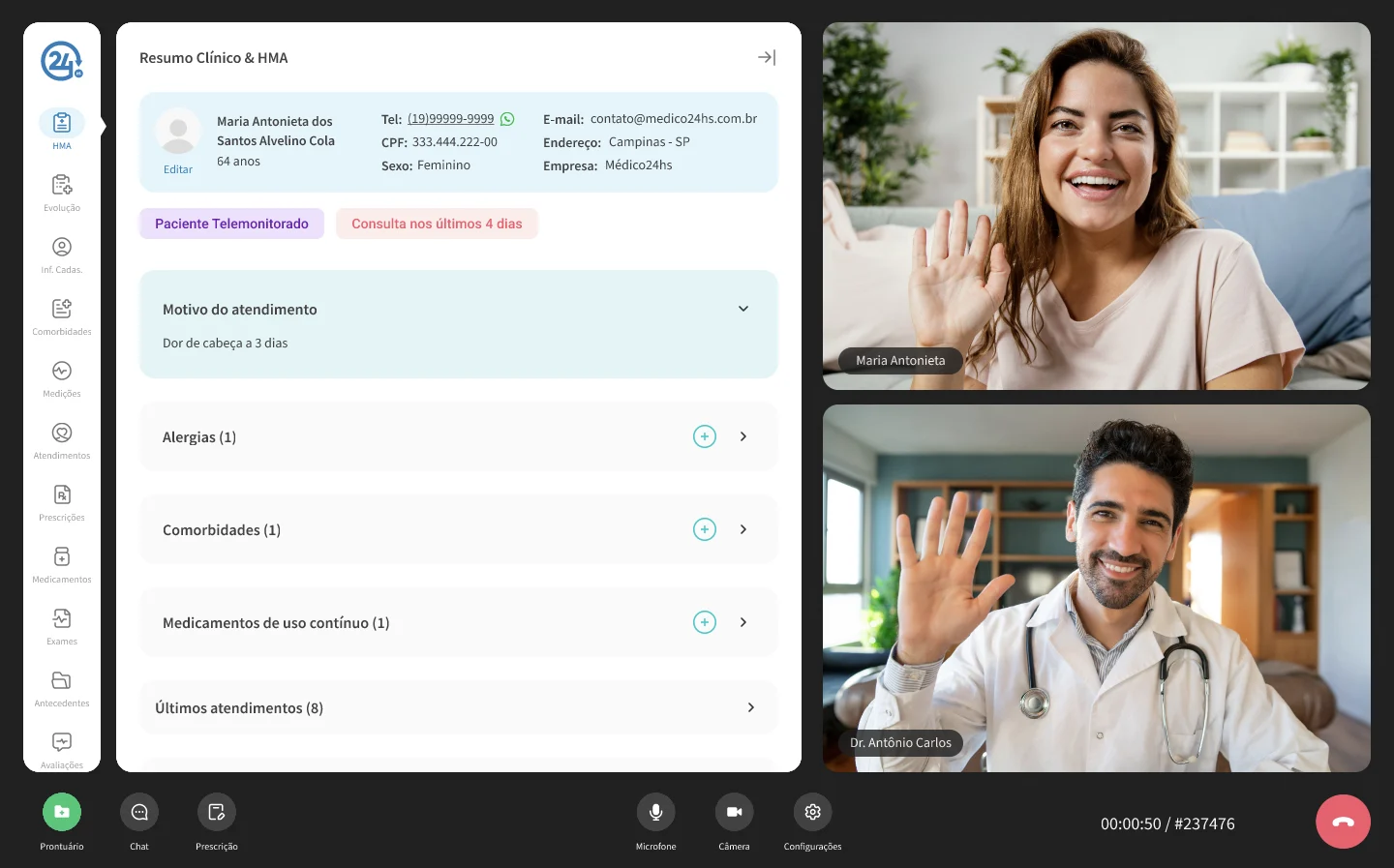
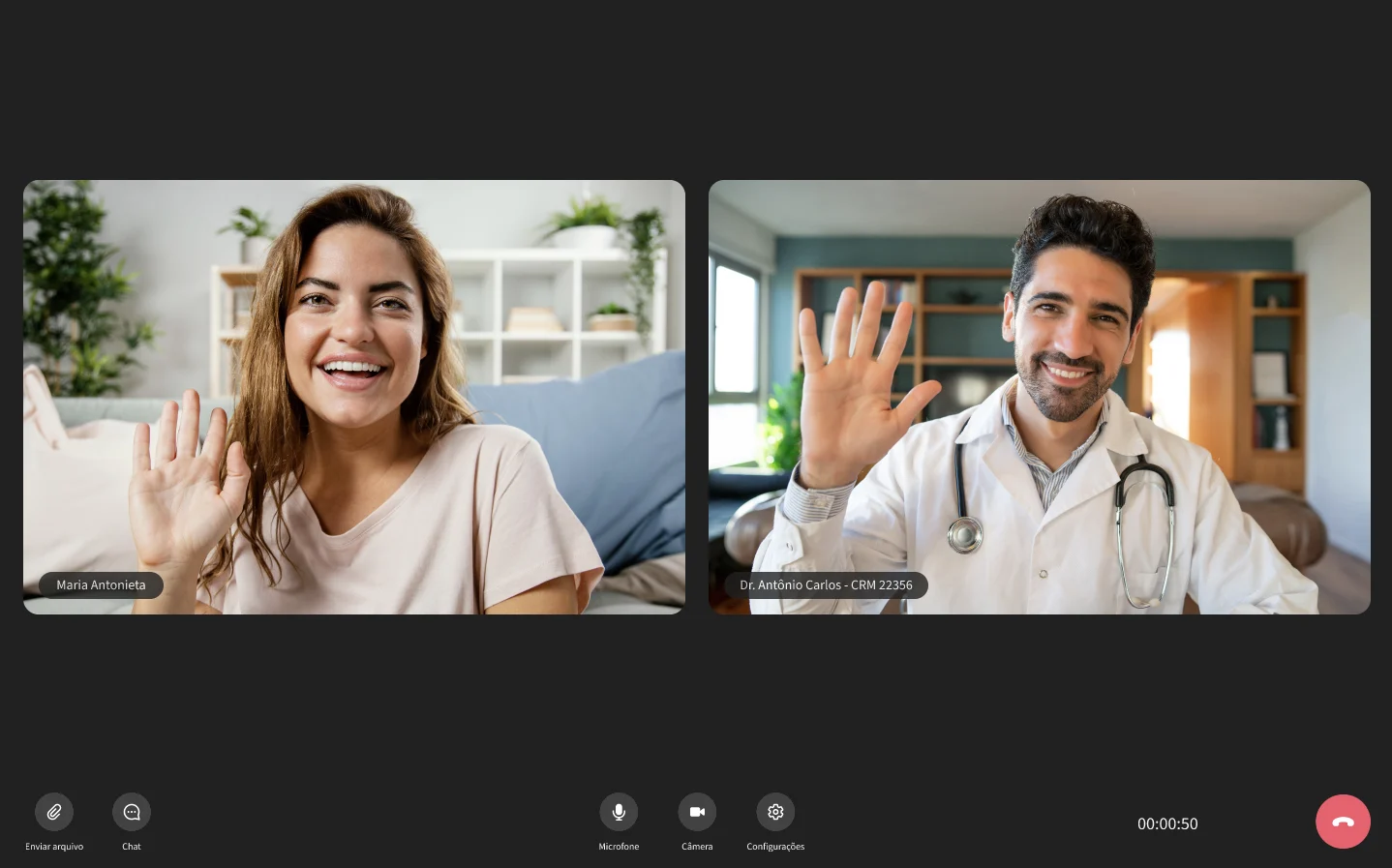
Screens with fictitious data.
When patients don't show up
Phase two added specialist appointments. Before the program, many patients waited up to a year to see a psychiatrist, neurologist, orthopedist or urologist. Nurses booked patients by phone, WhatsApp or at the front desk, and the patient came to the clinic at the scheduled time. Each specialist shift ran 4 hours, with 12 slots of 20 minutes.
Real life broke the grid fast. Some patients missed their slot while another patient in the waiting room wanted to be seen. Others arrived late and needed a slot that had just opened. I shipped a rule that lets the nursing team swap the patient on any slot up to its start time, so no specialist time goes to waste.
| Specialty | ESF Boraceia | ESF Mirosam | Total |
|---|---|---|---|
| Neurology | 69 | 65 | 134 |
| Psychiatry | 54 | 64 | 118 |
| Orthopedics and traumatology | 57 | 58 | 115 |
| Urology | 32 | 21 | 53 |
Specialist appointments completed, by clinic.
Speaking the public system's language
- Prescriptions limited to the municipal list. The city runs its own pharmacy and stocks the medicines in REMUME 2025. Physicians on our platform can normally prescribe from thousands of drugs. For this program, they work from that list, so patients leave with medicine they can actually pick up.
- Public health request forms. We added dedicated SADT forms (diagnostic and therapy requests) and APAC forms (high-complexity procedure authorization) to the consultation room.
- Formal sign-off. Every form and flow was formalized with and approved by the health department, and physicians were trained on when and how to use them.
What patients came for
Most visits were the low-complexity care that fills a clinic's waiting room: general symptoms, check-ups, colds, pain and prescription renewals. This is exactly the demand remote physicians can absorb, which frees the clinic's own team for patients who need to be seen in person.
Show as table
| Code | Diagnosis | Consultations |
|---|
A flow on paper is not a nurse's day
I went to the clinics in person, trained the nurses on site and remotely, and stayed close through the rollout. Designing what looks like the best path is one thing. Watching a nurse run it between phone calls, walk-ins and a full waiting room is another. The patient swap rule came straight from watching that routine.
A third unit joined for a short period to absorb a demand surge, using the same flow and back office.
More capacity, no new buildings
- Live in 15 days after kickoff, in March 2026.
- 5,296 urgent-care consultations and 420 specialist appointments delivered inside public clinics, for specialties where patients used to wait up to a year.
- Waiting times for walk-in care at the clinics dropped considerably. Official figures are held by the health department.
- 4,038 patients registered by the nursing team.
- 4.96 out of 5 patient satisfaction, with an average queue time of 97 seconds.
- A model that scales by unit: a third clinic joined temporarily during a demand surge.
What's next
The city plans to train community health agents to use tablets connected to the platform, taking teleconsultations to bedridden patients at home.